

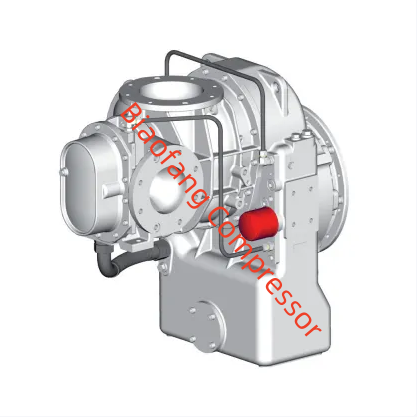
The GHH RAND CD23S Air End Ingersoll Rand is a single-stage, gear-driven, oil-free screw compressor block that is purpose-built for jet start applications — the compressed-air systems that spin aircraft and industrial gas turbine engines up to ignition speed. It is a specialized core, engineered for the kind of high-reliability, contaminant-free air delivery that a jet starter cannot compromise on.
I have spent enough time around ground support and turbine equipment to know that jet start is not a forgiving duty. A block that performs well in a general workshop is not automatically the right block when it has to spin a turbine cleanly, on demand, time after time. This guide walks through what the CD23S is, why it is built the way it is, and what you need to check when you are specifying or replacing one.
What "Jet Start" Actually Demands from an Air End
A jet start system uses a large volume of clean compressed air to drive a starter turbine, which in turn rotates a jet or gas turbine engine until it reaches self-sustaining ignition speed. The demand is sudden and intense: a short, high-flow burst rather than a steady industrial load. That single fact shapes every design decision in the GHH RAND CD23S Air End Ingersoll Rand.
Three requirements follow directly from that duty. First, the air must be genuinely oil-free, because any carryover introduced into the starter path ends up inside the engine. Second, the block must deliver high flow reliably on repeated start cycles without thermal drift. Third, it must be simple enough to stay dependable in remote, mission-critical settings where a failed start is not an option.
Quick take: the GHH RAND CD23S Air End Ingersoll Rand is a single-stage, gear-driven, oil-free screw block designed specifically for jet start and turbine starting systems — clean air delivered in a short, high-flow burst.
Key Features of the GHH RAND CD23S Air End Ingersoll Rand
The CD23S is defined by a handful of deliberate engineering choices, each one tied directly to the jet start mission:
- Single-stage compression. One compression stage keeps the block compact and mechanically straightforward — the right trade-off for burst duty rather than continuous high-pressure work.
- Gear-driven rotors. Precision timing gears synchronize the rotors and hold exact clearances without metal-to-metal contact, which is how the oil-free design stays reliable over thousands of cycles.
- Totally oil-free. No lubricant enters the compression chamber, so the starting air stays clean from inlet to the starter connection — essential when the air ends up in a turbine.
What distinguishes the CD23S from a general-purpose oil-free block is the "JET" designation. A standard industrial airend is tuned for steady-state efficiency over hours of run time. The GHH RAND CD23S Air End Ingersoll Rand is instead specified around repeated, high-flow start bursts, where cleanliness and repeatability matter more than marginal steady-state efficiency.
Where the CD23S Air End Is Used
The applications for this block cluster around turbine starting and clean-air ground support, where oil-free air is a hard requirement rather than a preference. Common settings include:
- Aircraft ground support and air-start carts used to spin up jet engines on the ramp
- Industrial gas turbine starting for power generation and compressor stations
- Test cells and facilities that require contaminant-free starting air for turbine machinery
- Any starting application where oil carryover could foul valves, or damage turbine internals
If your system feeds starting air into a turbine or any oil-sensitive downstream component, the CD23S is the block that was engineered for exactly that job. You can see where it sits within the wider GHH RAND range on our Ingersoll Rand GHH RAND category page.
Why Oil-Free Matters for Turbine Starting
In a lubricated rotary screw compressor, a small amount of oil inevitably travels with the compressed air, and downstream filtration is what removes it. In a turbine starting circuit, that approach is simply too risky. Oil that reaches a starter valve or a hot turbine section can coke, foul control components, or contaminate seals — problems that are expensive and difficult to trace after the fact.
An oil-free block removes the risk at the source. Because no lubricant ever enters the compression chamber, the air leaving the CD23S is clean by design, not by downstream treatment. That is precisely why a dedicated oil-free element like the GHH RAND CD23S Air End Ingersoll Rand is the standard choice in jet start systems rather than a modified oil-flooded core.
That design decision also simplifies the downstream system. With an oil-free core, there is no separator to service and no coalescing filter to replace on a strict schedule to guarantee purity — the air is clean at the point of compression, which removes a whole class of contamination-related failures from the starting circuit.
How to Specify the Correct CD23S Replacement
Replacing a jet start air end is not a task where you can afford to guess. Confirm the exact CD23S designation, verify the part number engraved on the existing block, and check whether your system is a genuine jet start application rather than a general industrial one. The GHH RAND CD23S Air End Ingersoll Rand is a specific element, and the fastest route to a correct quote is to send us the machine nameplate and existing part number together.
One habit that consistently prevents mis-orders: photograph the nameplate and the engraved number on the old block before you reach out. It removes an entire round of back-and-forth and makes sure the correct CD23S is quoted the first time.
Keeping a Jet Start Air End Reliable
Jet start equipment often sits idle for long stretches and then has to perform flawlessly on demand. That operating profile makes a few maintenance habits especially important. Keep the inlet filtration clean so abrasive particles cannot reach the rotors, drain moisture from the system so the block is not sitting against condensed water, and run a periodic functional check so a fault is found in the workshop rather than on the ramp.
- Inspect and replace inlet filters on a schedule, not on memory
- Drain accumulated moisture from receivers and low points regularly
- Log start-cycle count and any pressure drift between inspections
- Use genuine seals, gears, and filters whenever the block is serviced
Beyond the checklist, the most valuable habit is a documented baseline. Record the block's delivery pressure and cycle time when the equipment is healthy, then compare every future check against that baseline. On a mission-critical block like the CD23S, a slow drift in performance is the earliest warning you will get, and acting on it early is what keeps a start from failing at the worst possible moment.
When to Replace Your CD23S Air End
No air end lasts forever, and in jet start service the consequences of a worn block are immediate. Watch for a drop in starting-air delivery pressure or flow, longer cycle times to reach ignition speed, unusual noise or vibration, and visible wear or scoring on inspection. Because the CD23S is oil-free, wear cannot hide behind an oil change — it shows up directly in performance, which is actually a useful early-warning signal if you are paying attention.
Why Source Your CD23S from Biaofang
When the block is this specialized, the supplier matters as much as the part number. Here is what we bring at Biaofang:
Genuine GHH RAND cores. We supply the GHH RAND CD23S Air End Ingersoll Rand as a proper replacement element, not a look-alike copy.
Stated warranty. The CD23S block carries a 1–2 year warranty, so you are not buying blind.
Direct factory support. You deal with the source, which means faster answers on fitment, lead time, and technical questions.
Wide air-end range. The CD23S is one of many Ingersoll Rand GHH RAND elements we carry — see the full lineup on our Ingersoll Rand GHH RAND category page.
Frequently Asked Questions
Is the CD23S a direct replacement for my existing block?
Fitment depends on your starter system and original part number. The GHH RAND CD23S Air End Ingersoll Rand replaces the corresponding CD23S-designated block; send us your nameplate and existing part number and we will confirm the exact match before you order.
What does "JET" mean in the CD23S designation?
It marks the block as purpose-built for jet start and turbine starting applications — short, high-flow bursts of oil-free air — rather than continuous industrial duty. The compression core is the same reliable oil-free design, tuned for the burst profile that starting systems demand.
Why is oil-free air so important for turbine starting?
Oil carryover into a starter circuit can coke on hot components, foul valves, and contaminate turbine seals. An oil-free block removes the risk at the source, so the starting air is clean by design rather than by downstream treatment.
How long will the CD23S air end last?
Service life depends on cycle count, ambient conditions, and maintenance discipline. A well-maintained oil-free core running within its rated duty will deliver years of reliable starts; the block itself carries a 1–2 year warranty.
Need a Genuine GHH RAND CD23S Air End Ingersoll Rand?
Send us your starter nameplate and current part number, and we will confirm fitment and lead time for a genuine replacement block.
Confirm My CD23S Fitment