

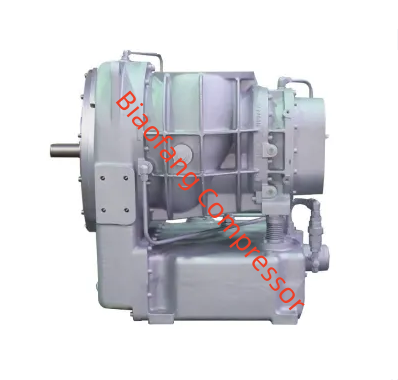
The GHH RAND CD72S1 Air End Ingersoll Rand is a single-stage, gear-driven, oil-free screw compressor block built for general industrial applications. It is the compression core that turns ambient air into clean, contaminant-free compressed air, and it is the part of an oil-free rotary screw compressor that actually does the work.
The plants I have worked with come to this block through two doors: either they are replacing a worn core on an existing oil-free machine, or they are moving away from oil-flooded compression because the air quality no longer meets their needs. Both paths end at the same question — is the CD72S1 the right core for the job. This guide answers that question head-on.
What Exactly Is the CD72S1 GHH RAND Air End?
An air end — also called an airend or compressor block — is the sealed element inside a rotary screw compressor where compression happens. Two interlocking rotors turn inside a precision-machined housing; as they rotate, the trapped volume between them shrinks and the air is squeezed to working pressure. In an oil-free block like the CD72S1, the rotors never come into contact with lubricant, so the delivered air stays clean from inlet to discharge.
GHH RAND is the German airend specialist whose rotating cores sit inside many Ingersoll Rand machines. A GHH RAND designation signals a core engineered to a tight, repeatable standard — something that matters enormously when you are matching a replacement element to an existing compressor or building a line that will run continuously.
Quick take: the GHH RAND CD72S1 Air End Ingersoll Rand is a single-stage, gear-driven, oil-free screw compressor block for general industrial use — clean compression with no oil in the air stream.
Key Features of the GHH RAND CD72S1 Air End Ingersoll Rand
Three design choices define the CD72S1, and they determine where the block fits and how it behaves under load:
- Single-stage compression. One compression pass keeps the block compact and mechanically straightforward — the right fit for moderate-pressure industrial duty.
- Gear-driven. Precision timing gears synchronize the rotors and hold exact clearances without metal-to-metal contact, the mechanical heart of a reliable oil-free design.
- Totally oil-free. No lubricant enters the compression chamber, so the air leaving the block is free of oil mist and carryover from the source.
What makes the GHH RAND CD72S1 Air End Ingersoll Rand a dependable industrial workhorse is the combination of a proven single-stage layout with gear-driven timing. The gears do the synchronizing, so the rotors never touch, and the oil-free chamber means the delivered air needs no downstream oil removal. That is a fundamentally cleaner starting point than a lubricated core.
Where the CD72S1 Air End Is Used
The CD72S1 is specified for general industrial applications, and it consistently lands in facilities where air purity and uptime both matter. Typical installations include:
- Food and beverage processing, where compressed air touches product or packaging
- Pharmaceutical and medical-device manufacturing with strict purity requirements
- Electronics and clean-room assembly, where trace oil ruins sensitive surfaces
- Textile, printing, and coating lines that need consistent, dry, clean air
If your operation fits any of these categories, the CD72S1 belongs on your shortlist. You can see how it sits within the wider line on our oil-free rotary screw compressor category page.
Oil-Free vs. Oil-Flooded: The Real Difference
If you are weighing the CD72S1 against an oil-flooded core, the decision comes down to air quality and what it costs to achieve it. In an oil-flooded compressor, lubricant is injected into the compression chamber and must be separated and filtered out downstream. In an oil-free block, no lubricant enters the chamber in the first place.
Here is the comparison I walk buyers through:
| Factor | Oil-Free (CD72S1) | Oil-Flooded |
|---|---|---|
| Air purity at source | Clean by design, no oil carryover | Oil present, removed downstream |
| Contamination risk | Removed at the source | Depends on filtration health |
| Best fit | Purity-critical, regulated industries | General use where some oil is acceptable |
How to Specify the Correct CD72S1 Replacement
Buying an airend is about matching the core to the machine frame and duty cycle, not picking the first part number that looks right. Verify the exact CD72S1 designation, confirm the part number engraved on the existing element, and check whether the block is oil-free rather than oil-flooded. The GHH RAND CD72S1 Air End Ingersoll Rand is a specific block, and the fastest route to a correct quote is to send us your machine nameplate and existing part number together.
One habit that consistently saves time: photograph the nameplate and the engraved number on the old element before you reach out. It eliminates a full round of back-and-forth and makes sure the correct CD72S1 is quoted the first time.
Installation Care: Alignment and Torque Matter
Airend replacement is precision mechanical work, and the two details that decide whether a new core lives a long life are alignment and torque. The block must be mounted so the drive coupling runs true, and fasteners must be torqued to the specified values. A block that is forced out of alignment will wear its bearings and gears prematurely, no matter how good the core itself is.
- Verify coupling alignment before and after final tightening
- Torque fasteners to the manufacturer's specified values, in sequence
- Confirm inlet and discharge connections are clean and free of debris
- Run a short functional check before returning the machine to full duty
If your team has rotary-screw rebuild experience, a supervised swap is realistic; otherwise, have a qualified technician handle the alignment and torque procedure. Getting this step right is what protects the warranty and gives the GHH RAND CD72S1 Air End Ingersoll Rand the clean start it needs.
Daily Monitoring That Protects a Continuous-Duty Block
A block that runs for long stretches at a time depends on its operating data to stay healthy, because small problems rarely announce themselves. The operators who get the longest life out of an oil-free core are the ones who make a short daily check part of the routine: discharge temperature, system pressure, and any unusual sound or vibration. A reading that drifts upward over weeks is a far better warning than a sudden failure.
Keeping those numbers in a simple log turns them from impressions into a trend. When you can see a slow climb in temperature or a gradual loss of pressure over time, you can schedule service at a convenient moment instead of reacting to a shutdown. That is the practical difference between running a compressor and truly maintaining it.
When to Replace Your CD72S1 Air End
No airend lasts forever, and catching the warning signs early is the difference between a planned swap and an emergency shutdown. Watch for a measurable drop in delivered pressure or flow at the same load, rising discharge temperature or frequent thermal trips, unusual noise or vibration, and increased energy draw for the same output. In an oil-free block, wear cannot hide behind an oil change — it shows up in performance, which is actually a useful early-warning system if you are paying attention.
Why Source Your CD72S1 from Biaofang
When you are buying a replacement compression core, the supplier matters as much as the part number. Here is what we bring to the table at Biaofang:
Genuine GHH RAND cores. We supply the GHH RAND CD72S1 Air End Ingersoll Rand as a proper replacement element, not a look-alike copy.
Stated warranty. The CD72S1 block carries a 1–2 year warranty, so you are not buying blind.
Direct factory support. You deal with the source, which means faster answers on fitment, lead time, and technical questions.
Wide air-end range. The CD72S1 is one of many Ingersoll Rand GHH RAND elements we carry — see the full lineup on our Ingersoll Rand GHH RAND category page.
Frequently Asked Questions
Is the CD72S1 a direct replacement for my Ingersoll Rand machine?
Fitment depends on your machine frame and original part number. The GHH RAND CD72S1 Air End Ingersoll Rand replaces the corresponding CD72S1-designated block; send us your nameplate and existing part number and we will confirm the exact match before you order.
What does "oil-free" actually guarantee?
It means no lubricant enters the compression chamber, so the delivered air is free of oil mist and carryover from the source. It does not mean zero maintenance — timing gears and cooling still require service — but it removes the contamination risk that matters most.
Can I install the CD72S1 myself?
Airend replacement is precision work, and alignment and torque are critical to the core's life. If your team has rotary-screw rebuild experience, a supervised swap is possible; otherwise, have a qualified technician handle the procedure to protect your warranty.
How long will the CD72S1 air end last?
Service life depends on duty cycle, ambient conditions, and maintenance discipline. A well-maintained oil-free core running within its rated duty will deliver years of reliable service; the block itself carries a 1–2 year warranty.
Need a Genuine GHH RAND CD72S1 Air End Ingersoll Rand?
Send us your machine nameplate and current part number, and we will confirm fitment and lead time for a genuine replacement block.
Confirm My CD72S1 Fitment